Supervisi Keperawatan sebagai Determinan Motivasi dan Kepuasan Kerja Perawat pada Instalasi Rawat Inap RSUD Lamaddukelleng Kabupaten Wajo
DOI:
https://doi.org/10.0425/vfq86j82Keywords:
Nursing Supervision, Work Motivation, Job Satisfaction, Staff NursesAbstract
Nursing supervision is one of the essential managerial functions that plays a crucial role in enhancing nurses' work motivation and job satisfaction, thereby contributing to the quality of nursing care. This study aimed to analyse the relationship between nursing supervision and nurses' work motivation and job satisfaction in the Inpatient Department of Lamaddukelleng Regional General Hospital, Wajo Regency. This research employed a quantitative approach using a cross-sectional study design. The study population consisted of all staff nurses working in the inpatient wards, with a total sample of 83 respondents selected using the total sampling technique. Data were collected using a structured Likert-scale questionnaire and analysed through univariate and bivariate analyses using the Chi-square test with a 95% confidence level. The univariate analysis showed that most respondents perceived nursing supervision as being at a high level (90.4%). However, the majority of nurses demonstrated low work motivation (53.0%), while all respondents reported high job satisfaction (100%). The bivariate analysis revealed a significant relationship between nursing supervision and nurses' work motivation (p = 0.002), as well as between nursing supervision and nurses' job satisfaction (p = 0.006). These findings indicate that effective nursing supervision contributes to improving nurses' work motivation and job satisfaction. Therefore, hospital management is encouraged to strengthen the implementation of clinical supervision through continuous coaching, mentoring, and structured evaluation to enhance nurses' motivation, job satisfaction, and the quality of nursing services, particularly among contract nurses.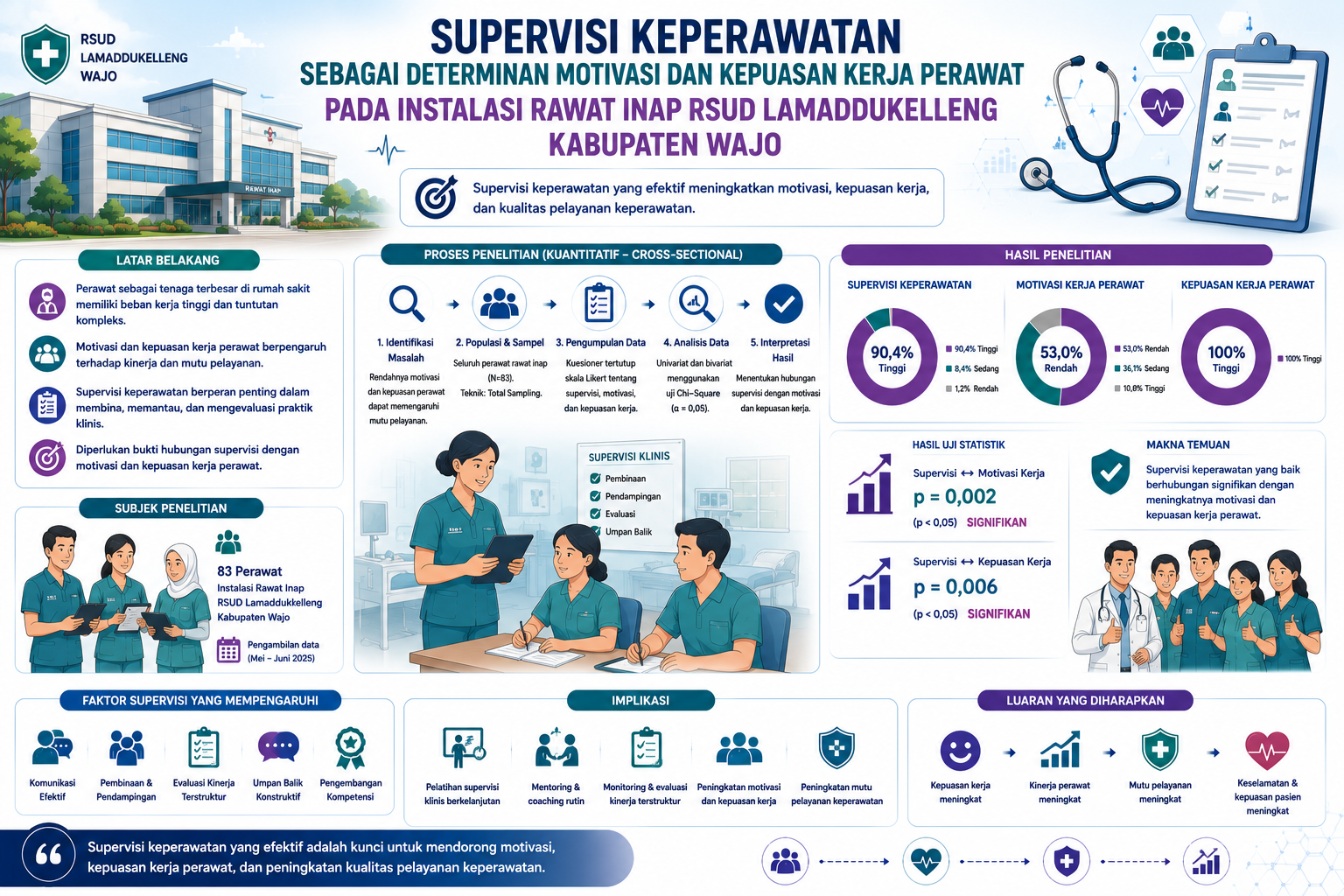
Downloads
Published
2026-06-30
Issue
Section
Articles